
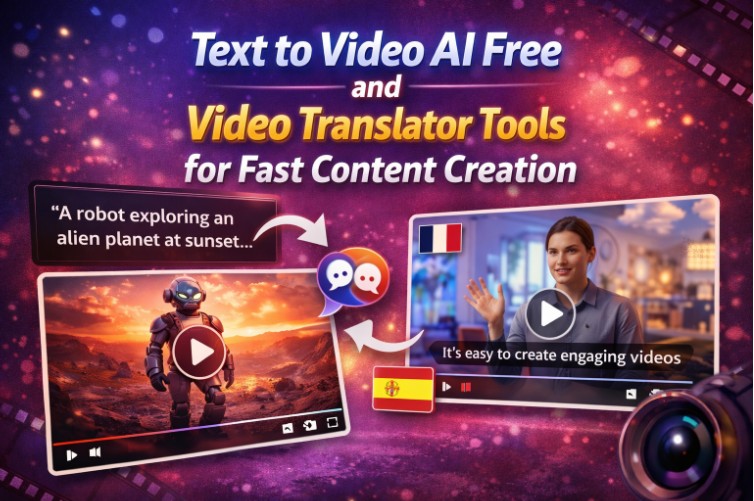
Creating videos used to take hours of editing, expensive software, and sometimes even a full production team. Now, AI is changing everything. With text to video AI free tools, you can generate videos from simple written prompts. And with a video translator, you can instantly adapt your content for audiences in different languages.
This combination is a game-changer for content creators, educators, and businesses who want to grow faster and reach a global audience without increasing production costs.
What Is Text to Video AI and How Does It Work?
Text to video AI is a type of artificial intelligence that converts written text into video content. You provide a script, idea, or prompt, and the AI generates a video by creating scenes, visuals, animations, and sometimes voice narration to match the text.
Most tools use machine learning models trained on large datasets of videos, images, and language patterns. This helps the AI understand what your text means and how it should look visually. The result is a video that feels like it was created by a human editor—only much faster.
Why Text to Video AI Free Tools Are Becoming So Popular
The main reason these tools are exploding in popularity is simple: they save time and money. Many people want to create videos for TikTok, YouTube Shorts, Instagram Reels, or marketing campaigns, but they don’t want to spend hours editing.
Text to video AI free tools also remove the need for technical skills. You don’t need to know how to use editing software or motion graphics. If you can write a short script, you can create a video.
Another big advantage is speed. Instead of planning, filming, and editing, you can generate a full video within minutes and publish it instantly.
What Is a Video Translator and Why Do People Use It?
A video translator is a tool that converts the language of a video into another language. This can include translating subtitles, translating voiceovers, or even creating a dubbed version of the video in a new language.
Video translation has become essential because audiences are global. A creator in English can gain viewers in Spanish, French, Arabic, or Hindi by translating their content. Businesses can also expand internationally without filming new content for each region.
Many modern video translators use AI to detect speech, convert it into text, translate it, and then generate subtitles or audio in the target language.
Key Features to Look for in a Text to Video AI Free Tool
Not all text to video AI free tools are the same. Some are designed for quick social media clips, while others focus on more polished videos. A good tool should offer customization options so you can control the style, format, and pacing.
You should also look for features like auto captions, voiceover options, and the ability to adjust scenes. These details matter because they make your final video look more professional and engaging.
Even with free tools, the best platforms usually provide templates, basic editing controls, and multiple video formats for different platforms.
Key Features to Look for in a Video Translator
A strong video translator should deliver accurate translations and sync them properly with the video. Timing is important because subtitles that appear too early or too late can make videos hard to follow.
High-quality video translators also support multiple languages, and many offer AI dubbing. Some even include voice cloning and lip-sync features, although these are often limited in free versions.
The best tools keep the translated audio natural, clear, and easy to understand—without sounding robotic.
Text to Video AI Free vs. Video Translator: What’s the Difference?
Although both tools involve AI and video content, they serve different purposes. Text to video AI free tools create videos from scratch using written text. A video translator works on existing videos to convert them into other languages.
One is focused on creation, while the other is focused on adaptation. When used together, they become extremely powerful. You can generate a video quickly using text to video AI, then translate it for multiple audiences using a video translator.
This makes it possible to create one piece of content and distribute it worldwide without recreating the video each time.
How to Use Text to Video AI Free and a Video Translator Step by Step
The process is usually straightforward. First, you write a short script or prompt and paste it into your text to video AI tool. Then you select the style, format, and voice options if available. Once the AI generates your video, you review it and make small edits if needed.
After the video is ready, upload it into a video translator. Choose your target language, select whether you want subtitles or dubbing, and let the AI process the translation. Finally, export the translated version and publish it.
Most creators repeat this step for multiple languages to reach different audiences.
Best Use Cases for Text to Video AI and Video Translator Tools
Text to video AI free tools are perfect for fast content creation, especially short-form videos. They work well for storytelling, motivational clips, educational content, product promotions, and social media posts.
Video translators are best for creators and businesses who want to scale globally. They are widely used for YouTube channels, online courses, marketing videos, and tutorials.
Together, these tools are especially powerful for anyone trying to grow an audience across different countries and languages.
Are Text to Video AI Free and Video Translator Tools Safe to Use?
Most reputable AI platforms are safe, but users should still be cautious. Since these tools require uploading text, voice, or video content, it’s important to review the platform’s privacy policy.
You should avoid uploading sensitive personal videos or private information. If the tool offers voice cloning or dubbing, it’s also important to use it ethically and avoid impersonating others.
As long as you choose trustworthy tools and use them responsibly, these AI platforms can be both safe and extremely useful.
Future of AI Video Creation and AI Video Translation
AI video creation and translation tools are improving rapidly. In the near future, text to video AI will generate more realistic visuals, smoother animations, and better storytelling structures. Video translators will also improve in accuracy, voice realism, and lip-sync performance.
We can also expect better customization, faster rendering, and more languages supported in free tools. As AI becomes more advanced, video production and translation will become even more accessible for everyone
Final Thoughts
If you want to create content quickly and reach a wider audience, text to video AI free tools and a video translator can make a huge difference. One helps you create videos instantly from text, while the other helps you adapt your content for different languages and regions.
Together, they offer an efficient way to produce high-quality content, save time, and grow globally without needing a big budget.